
Ever walked out of a room, forgotten to turn off the lights, and wondered how long they’ve been burning? You’re not alone. Fortunately, modern smart lighting makes it easier to control when and where your lights are used.
Energy-efficient smart lighting combines LED technology, automated schedules, motion sensors and convenient controls to help households manage electricity use. Instead of relying entirely on remembering to flip a switch, smart lighting gives homeowners more ways to control their lights.
Let’s explore how smart lighting works, where it can help reduce energy waste and what to consider when upgrading your home.
Smart lighting refers to lighting systems that offer additional control through features such as mobile apps, timers, sensors, dimming and compatible smart-home platforms.
Many smart lighting products use LED technology, which generally consumes less electricity than traditional incandescent bulbs while providing comparable illumination.
However, not every smart light offers the same features. Some focus on changing colors and creating atmosphere, while others emphasize automation, motion detection or convenient everyday control.
The right combination depends on your home, your lighting habits and what you want to achieve.
One of the simplest ways to improve lighting efficiency is to replace older incandescent bulbs with efficient LED alternatives.
LED bulbs use less electricity to produce light and typically last much longer than traditional incandescent bulbs.
That means switching to LEDs can reduce electricity consumption and the frequency of bulb replacements.
Smart LED bulbs add another level of convenience by allowing compatible devices to control brightness, set schedules and automate everyday lighting.
The energy savings from automation depend on how you use the lights, but the combination of efficient LEDs and thoughtful controls can help reduce unnecessary electricity use.
Explore our smart lighting collection to discover different lighting options for your home.
How often do lights get left on in hallways, closets, bathrooms, stairways or other areas that aren’t occupied all day?
Motion sensor lighting offers a practical solution.
Instead of requiring someone to turn a light on and off manually, a motion sensor can activate compatible lighting when movement is detected. Depending on the product, the light may switch off automatically after a period without activity.
This can be especially convenient in spaces where people frequently enter and leave.
For example, motion-activated under-cabinet lighting can illuminate a kitchen workspace when needed without requiring the lights to remain on continuously.
Check out our rechargeable motion sensor under-cabinet lights for one example of convenient lighting technology.
One of the most useful smart-lighting features is the ability to create schedules.
Instead of manually turning lights on and off every day, compatible smart lighting systems can follow schedules based on your household’s routine.
For example, you might schedule outdoor lighting to turn on in the evening and switch off in the morning.
Indoor lights can also follow routines that match when rooms are normally occupied.
The biggest advantage is consistency. A schedule can help prevent lights from staying on unnecessarily simply because someone forgot to turn them off.
For households with predictable daily routines, this can be a convenient way to manage lighting use.

Not every situation requires lighting at full brightness.
Watching television, relaxing in the evening or creating a comfortable atmosphere may call for softer illumination.
Compatible smart bulbs and lighting systems allow you to adjust brightness to suit different activities.
Dimming an LED light can reduce its electricity consumption, although the amount saved depends on the bulb, driver and dimming system.
Brightness controls also offer flexibility, allowing the same lighting fixture to serve multiple purposes throughout the day.
Want more inspiration? Read our guide to Smart Lighting Ideas to Highlight Your Home’s Best Features.
Smart lighting can become even more useful when connected to compatible smart-home technology.
Depending on the system, homeowners may be able to control lights using a smartphone, voice assistant, automation platform or connected sensors.
For example, compatible devices may support routines that turn off selected lights when everyone leaves home or adjust lighting at a scheduled time.
The goal is to make everyday lighting easier to manage while reducing unnecessary use.
Keep in mind that compatibility varies between products and smart-home ecosystems.
Learn more in our article about Smart Lighting and Smart Home Integration.
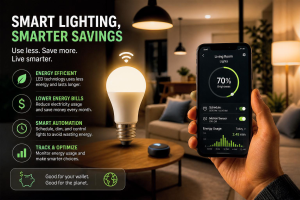
Smart lighting can help reduce electricity consumption, but the financial benefit depends on several factors.
These include the type of bulbs you’re replacing, how many lights you use, how long they remain on, your local electricity rates and how effectively you use automation.
Replacing frequently used incandescent bulbs with efficient LEDs may produce noticeable savings.
Adding schedules and motion sensors can help further by reducing unnecessary lighting time.
However, installing smart features on already-efficient LED bulbs won’t automatically produce substantial savings. Smart devices may also consume small amounts of standby power.
The most useful approach is to identify where electricity is currently being wasted and choose lighting features that address those habits.
Outdoor lighting can improve visibility around entrances, walkways, patios and other areas of your property.
However, leaving outdoor lights on unnecessarily can increase electricity use.
Depending on the product, outdoor lighting with timers, motion detection or other automatic controls can help manage when lights operate.
Motion-activated lighting can be particularly useful in areas that only require illumination when someone approaches.
For homeowners looking to improve both convenience and efficiency, selecting the right outdoor lighting controls can make a meaningful difference.

Before purchasing smart lighting, consider where and how the lights will be used.
Start by identifying areas where lights frequently remain on unnecessarily. Hallways, kitchens, closets and outdoor spaces may benefit from different types of controls.
Then compare features such as LED efficiency, brightness, motion detection, scheduling, battery life, connectivity and smart-home compatibility.
For LED bulbs, look at the brightness in lumens and the electricity consumption in watts rather than assuming that every smart bulb has the same efficiency.
For rechargeable lights, consider how frequently they’ll need charging and whether they provide enough illumination for the intended location.
You don’t need to replace every light in your home at once. Starting with one or two frequently used areas can help you determine which features are genuinely useful.
Smart lighting technology continues to evolve.
Improvements in LED efficiency, sensors, wireless connectivity and automation could make lighting systems increasingly convenient and responsive.
More advanced systems may use occupancy information, available daylight and household routines to adjust illumination automatically.
For homeowners, the opportunity is to create lighting that works around their daily activities rather than relying entirely on manual switches.
The most effective systems will balance convenience, comfort, appropriate illumination and responsible energy use.
Smart lighting isn’t just about controlling bulbs from your phone or changing the color of a room.
It’s about using lighting more thoughtfully.
Energy-efficient LEDs can reduce electricity consumption compared with older bulbs. Motion sensors can help prevent lights from staying on in empty spaces. Schedules and automation can make everyday lighting easier to manage.
Together, these features offer homeowners practical ways to improve convenience while potentially reducing electricity costs.
Ready to upgrade your lighting? Explore smart lighting at Today’s Gadget Needs and discover lighting options for your home.
“Want to see how this works in real life? Check this out.
