
When an emergency happens, every second matters. First responders need accurate information quickly, especially when conditions are dangerous, visibility is limited, or reaching an area on foot could put additional lives at risk.
Drones are becoming valuable tools in emergency response and public safety because they can provide an aerial view of difficult situations without immediately putting a person in harm’s way.
From search-and-rescue missions and wildfires to floods, storms, and disaster assessment, drone technology is changing how emergency teams can gather information and respond when it matters most.
One of the biggest advantages of drones in emergency response is their ability to quickly provide a view from above.
Traditional emergency assessments may require responders to physically enter an area, use helicopters, or rely on information gathered from the ground.
A drone can potentially reach some locations faster and provide live or recorded aerial imagery that helps responders understand what’s happening before sending personnel into an area.
This additional perspective can help emergency teams make better-informed decisions while reducing unnecessary exposure to dangerous conditions.
Interested in seeing how today’s drone technology continues to evolve? Explore drones at Today’s Gadget Needs.
Search-and-rescue operations are one of the most promising applications for emergency-response drones.
When someone becomes lost in a large wooded area, mountainous terrain, near water, or after a natural disaster, searching every location from the ground can take considerable time.
Drones can help teams survey large areas from above and identify locations that may deserve closer attention.
Some specialized drones can also use thermal imaging technology to detect heat signatures. In certain conditions, that can provide search teams with another tool for locating people when normal visibility is limited.
Drones don’t replace trained search-and-rescue professionals. Instead, they can provide additional information that helps those professionals focus their efforts.
Wildfires create extremely dangerous and rapidly changing conditions.
Smoke, heat, wind, terrain, and changing fire behavior can make it difficult for firefighters to understand exactly where the greatest threats are developing.
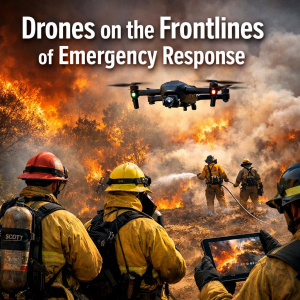
Drones can provide aerial imagery that helps emergency personnel observe fire conditions from a safer distance.
Specialized systems equipped with thermal imaging may also help identify hot spots or areas where heat remains after visible flames have decreased.
Information gathered from above can contribute to a more complete understanding of what’s happening on the ground.
Floods, hurricanes, tornadoes, and severe storms can make roads inaccessible and entire areas difficult to reach.
After a major weather event, drones can be used to survey damaged neighborhoods, flooded roads, bridges, buildings, and other infrastructure.
That aerial perspective can help responders identify heavily affected areas and determine where additional assistance may be needed.
Drones may also help document damage after an emergency, providing imagery that can support recovery efforts and future planning.
Understanding the full scale of a disaster can be difficult from ground level.
Drone imagery can help create maps and visual records of affected areas. Emergency planners and response teams can use this information to better understand damage, identify possible access routes, and prioritize areas that need attention.
As drone cameras, positioning technology, and mapping software continue to improve, aerial information can become increasingly detailed.
This is especially valuable when conditions are changing quickly and responders need current information rather than relying entirely on older maps or reports.
One of the most important benefits of emergency-response drones is the ability to gather information without immediately sending a person into a potentially dangerous location.
Collapsed structures, fires, floods, unstable terrain, hazardous areas, and other emergency environments can put responders at significant risk.
A drone may be able to provide an initial look at an area so emergency personnel have more information before deciding how to approach it.
Technology should never replace the judgment and expertise of trained emergency professionals, but it can give them another valuable tool for assessing risk.
Another developing use for drones is transporting small emergency supplies.
Depending on the situation and equipment, drones may potentially be used to transport items such as medical supplies or other lightweight necessities to locations that are difficult to reach quickly.
This could be especially valuable when roads are blocked, terrain is difficult, or traditional transportation would take too long.
The capabilities and regulations surrounding drone delivery vary, but the concept demonstrates how drones could eventually become useful for more than observation during emergencies.
Using drones for public safety doesn’t eliminate the need for responsible operation.
Emergency areas may have complicated airspace considerations, other aircraft, temporary flight restrictions, and rapidly changing conditions.
Unapproved drone activity can potentially interfere with professional emergency operations, which is why recreational pilots should always check current restrictions and avoid interfering with first responders.
If you’re interested in this side of drone ownership, read our guide to Drone Safety, Privacy and Regulations: What You Need to Know.
Understanding responsible drone operation is important whether you’re flying for recreation, photography, or another purpose.
Modern consumer and professional drones can include features such as GPS positioning, optical-flow hovering, obstacle detection, automatic return functions, high-resolution cameras, and other flight-assistance technology.
These features can make drones easier to operate and demonstrate how quickly the technology is advancing.
For people interested in exploring today’s consumer drone technology, browse the latest drones at Today’s Gadget Needs and compare the different camera and flight features available.
Consumer drones aren’t substitutes for specialized public-safety equipment, but many of the underlying technologies demonstrate how drone capabilities continue to improve.
The future of emergency-response drones could become even more advanced.
Improvements in artificial intelligence, thermal imaging, obstacle detection, navigation, battery technology, communications, and automated flight could allow drones to provide emergency teams with even more useful information.
Future systems may become better at mapping disaster areas, identifying objects or unusual conditions, coordinating multiple aircraft, and operating in environments that are difficult for people to reach.
As these capabilities improve, regulations, safety procedures, privacy protections, and responsible operation will remain important.
Some of the most exciting technology isn’t simply entertaining—it can help solve real problems.
Drones are a great example.
The same basic idea that allows someone to capture an amazing aerial video can also be adapted into sophisticated technology for search and rescue, disaster assessment, firefighting, mapping, and public safety.
Drones won’t replace firefighters, police officers, paramedics, search-and-rescue teams, or other emergency professionals.
Instead, their greatest potential may be helping those professionals see more, understand situations faster, and reduce unnecessary risks.
As drone technology continues to evolve, its role in emergency response and public safety is likely to become even more important.
Interested in seeing where drone technology is headed? Explore drones at Today’s Gadget Needs and discover today’s latest flying technology.
See how police and emergency teams are using Drones in real-time situations to improve response speed, increase safety, and save lives during critical incidents.
