
Photography and filmmaking have always been about finding the perfect angle. Thanks to drones, sometimes that perfect angle happens to be hundreds of feet above the ground.
Drone photography and filmmaking have changed the way creators capture landscapes, events, real estate, travel adventures, and cinematic footage. Shots that once required helicopters, cranes, or expensive equipment can now be captured with increasingly capable camera drones.
From beginners experimenting with aerial photography to experienced creators looking for unique perspectives, drones have opened an entirely new world of visual possibilities.
Before camera drones became widely available, capturing professional-looking aerial footage could be complicated and expensive.
Today, a compact drone equipped with a high-resolution camera can provide perspectives that would otherwise be difficult to capture.
Photographers can fly above landscapes and buildings, while filmmakers can create sweeping establishing shots, overhead perspectives, and smooth moving footage.
That accessibility is one reason drone photography has become so popular.
Want to see what modern camera drones can do? Explore drones at Today’s Gadget Needs.
One of the biggest advantages of drone photography is perspective.
We’re accustomed to seeing the world from eye level. Moving the camera into the sky can completely change the appearance of an ordinary scene.
A coastline, neighborhood, mountain, field, road, or building can reveal shapes, patterns, and details that aren’t obvious from the ground.
Drone photographers can experiment with altitude, camera angle, composition, lighting, and movement to create images that stand apart from traditional photography.
Sometimes the most interesting photograph isn’t straight ahead—it’s straight down.
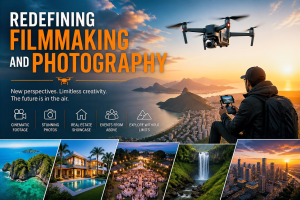
Drones aren’t limited to still photography.
Modern camera drones can capture aerial video while moving through the environment, giving filmmakers opportunities to create dramatic sequences.
A drone can potentially follow a landscape, move toward a subject, rise above an obstacle, reveal a scene from behind a building, or slowly pull away to show the scale of an environment.
These movements can make video content feel more cinematic and engaging.
The key isn’t simply flying higher. Good drone filmmaking combines controlled movement, thoughtful composition, lighting, and storytelling.
Travel photography is another area where drones can provide a completely different perspective.
Beaches, mountains, lakes, trails, forests, and scenic destinations can look dramatically different from above.
A drone can capture the scale of a landscape in ways that traditional ground-level photography sometimes cannot.
For travelers and outdoor enthusiasts, this creates another way to document experiences and create memorable photos and videos.
Before flying at an unfamiliar destination, however, always check local regulations and airspace restrictions.
Drone photography has also become useful for showcasing homes, land, and commercial properties.
Traditional photographs can show individual rooms and exterior features, but aerial images can provide additional context.
For example, an aerial perspective can show a property’s layout, surrounding land, landscaping, nearby features, and overall setting.
Video can add another dimension by creating smooth aerial approaches or property flyovers.
For larger properties especially, aerial imagery can help viewers understand the property in a way that individual ground-level photographs may not.
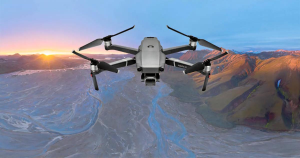
Social media has helped make aerial photography more accessible and recognizable.
Creators can use drone footage for travel videos, social posts, promotional content, YouTube videos, short-form videos, and other digital projects.
Because aerial footage provides an unusual viewpoint, it can help grab attention when it’s used creatively.
But an impressive drone shot still needs a purpose.
The best content isn’t necessarily the footage taken from the greatest altitude. Sometimes a slow, controlled flight just above a landscape creates a much stronger visual.
If photography or video is one of your main reasons for buying a drone, the camera isn’t the only feature worth considering.
Several features can affect the overall experience.
Higher-resolution cameras can capture additional image detail, although resolution alone doesn’t determine overall image quality.
Stable hovering and controlled flight can make it easier to frame photographs and capture smoother video.
GPS-equipped drones may offer useful positioning and flight features that make aerial photography easier to manage.
Obstacle-detection technology can help pilots maintain awareness of objects around the drone, although pilots should never rely entirely on automated systems.
Return-to-home functionality can provide an additional layer of convenience when supported by the drone and used properly.
Longer flight time gives photographers and filmmakers more opportunities to position the drone and capture the shot they’re looking for.
You can browse drones at Today’s Gadget Needs to compare available camera and flight features.
Getting the perfect shot should never come before responsible flying.
Drone operators need to be aware of people, buildings, wildlife, weather conditions, restricted areas, and applicable flight regulations.
Privacy should also be considered when photographing or recording areas where people may reasonably expect privacy.
Understanding the rules before flying helps protect the pilot, the drone, other people, and the surrounding environment.
For more information, read our guide to Drone Safety, Privacy and Regulations.
The technology that makes aerial photography possible is also being used for much more than creating great pictures.
Drones are increasingly used in agriculture, environmental monitoring, emergency response, mapping, inspection, and other applications.
For example, farmers and researchers can use aerial imagery to examine large areas from above. Learn more in How Drones Are Transforming Agriculture and Conservation.
Drones can also provide aerial information during emergencies and disasters. Read more in Drones in Emergency Response and Public Safety.
These applications demonstrate how the same basic concept—a flying camera and sensor platform—can serve very different purposes.
Camera drone technology continues to improve.
Better cameras, improved stabilization, smarter flight modes, obstacle detection, longer flight times, and automated tracking could make aerial content creation even easier and more accessible.
Artificial intelligence may also play a larger role by helping drones track subjects, plan movements, maintain framing, and automate certain filming techniques.
For creators, that means the barrier between imagination and capturing the shot could continue to shrink.
Drone photography and filmmaking aren’t simply about putting a camera in the sky.
They’re about seeing familiar places from unfamiliar perspectives.
Whether you’re photographing a landscape, documenting a trip, creating social media content, filming a property, or simply experimenting with aerial photography, drones provide creative possibilities that weren’t easily accessible to everyday consumers just a few years ago.
The technology will continue changing, but one thing probably won’t: photographers and filmmakers will always be looking for a better angle.
Sometimes you just have to fly to find it.
Ready to explore aerial photography for yourself? Check out the latest drones at Today’s Gadget Needs.
